
Khazalite Holds, the Ancestor Gods

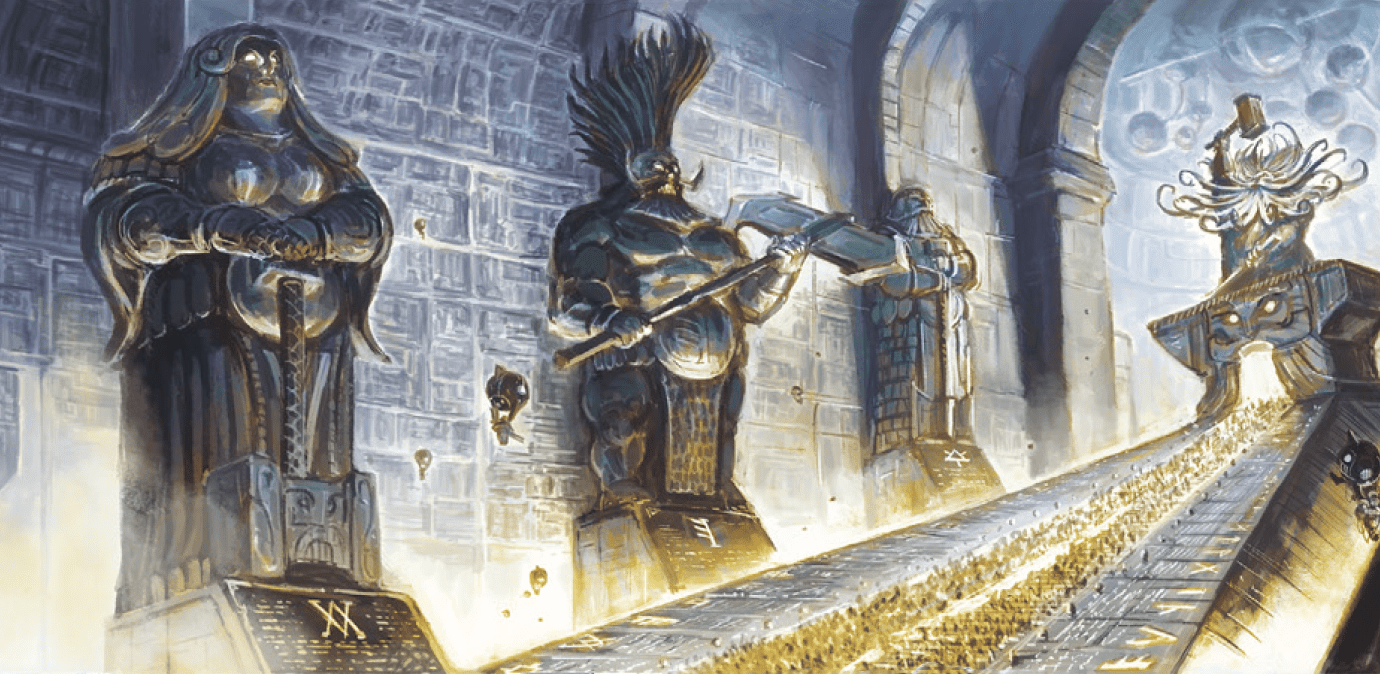
Long before the Khazalite Holds lit their forges, long before their strongholds even rose deep within the mountains, the duardin already worshipped an ancient pantheon of deities who represented the fundamental pillars of their civilization: craftsmanship, warfare, family, respect for their ancestors, and many others that have been lost over time.
During the Age of Myth, this pantheon of gods, known as the Ancestor Gods, was a group of powerful deities who, according to ancient legends, guided the first duardin clans and helped forge their identity. Many have been forgotten over the ages, but some remain fundamental pillars of duardin beliefs to this day.
For the Khazalite Holds, the pantheon consists of eight Ancestor Gods, although the Khazalites worship only seven. Originally, they were mortal beings who ascended to godhood and embody the fundamental values of duardin culture.
GRUNGNI
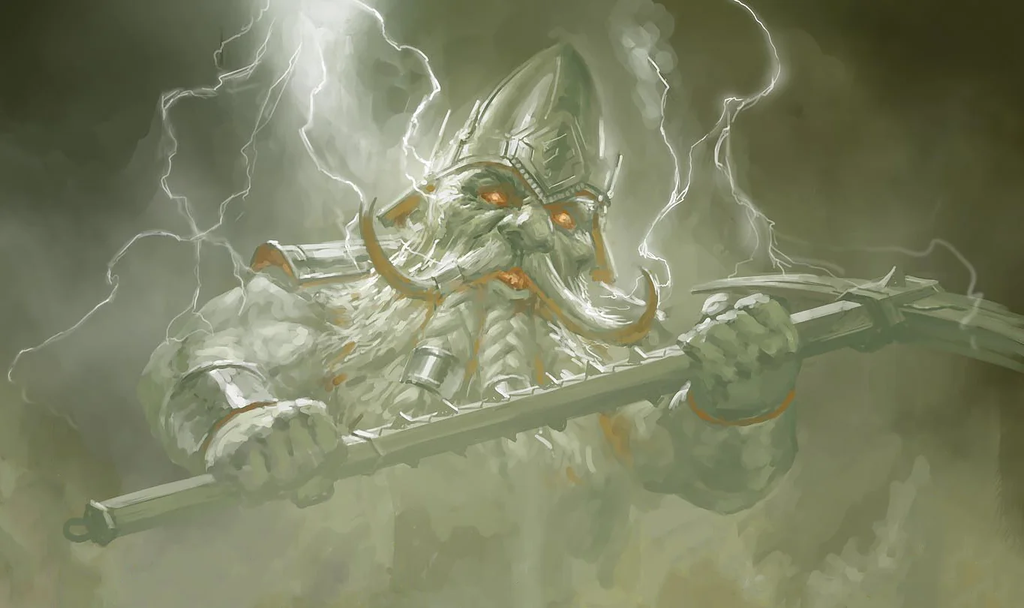
God of the forge, patron of blacksmiths, craftsmen, engineers, and builders. He is considered the father of the gods and the most revered of the ancestors. He helped develop duardin civilizations during the Age of Myth. Towards the end of the Age of Chaos, he assisted Sigmar in all his projects, including the Sigmarabulum, and was also the driving force behind the Khazalite Holds during the Age of Sigmar.
He appears as a blacksmith, with a thick grey beard, a leather apron, and a belt carrying seven hammers. While some consider him stern and demanding, others believe he tests his people to strengthen them, just as steel is tempered through fire and hammer blows. His influence is particularly tied to Chamon, the Realm of Metal.
GRIMNIR
Grimnir embodies the fiercest warrior spirit of the duardin. Known as the Fearless, he is the god of the axe and battle, renowned for his courage, fiery temper, and recklessness.
Driven by his pride and his desire to repay his debt to Sigmar, who had freed him from the Iron Mountains, he confronted Vulcatrix, the godbeast. Their titanic battle shattered mountains and tore enormous rifts in the earth, until both ultimately perished in a fateful duel.
The Fyreslayers believe that a part of Grimnir’s spirit survived his death and was scattered across the realms in the form of ur-gold. For this reason, the Zharrgrim priests consider this metal sacred and use it to keep the essence of their god alive.
Although his possible return remains uncertain, the Fyreslayers continue to worship him, convinced that his spirit remains among them. Grimnir symbolizes the strength, ferocity, and indomitable spirit of the duardin, reminding them that they must always keep the flame of their wrath and determination burning.
VALAYA
Goddess of the hearth, family, and strongholds, known as the Defender, who offers protection and healing to the duardin. Although she embodies kindness and compassion, she also possesses a strong character and great determination, and is associated with brewing. In ancient times, she acted as a mediator among the Ancestor Gods, but when Hashut fell to Chaos, Valaya attempted to redeem him. When she failed, she was the one who ultimately struck him down, weeping inconsolably over his loss. She disappeared after the Thagduegi, the Great Betrayal, and to this day, the reason for her disappearance remains a great mystery.
Following Hashut’s fall, Valaya vanished for a long period, consumed by a profound grief that not even the hardships of the Age of Chaos could ease. However, she eventually returned to help her people reclaim what they had lost. Depicted as a fierce warrior priestess, armed with a runic axe and a jewel-adorned helm, Valaya is deeply loyal to the Ancestor Gods, although she is also the only one capable of challenging Grungni’s will.
Stronghold builders revere her as the protector of duardin settlements, while brewers regard her as their patron goddess. Among her greatest feats is the defence of Karag Thryngaz, where she extinguished the black fire of the ur-drakk Othmarrag, defeated several enemies, and purified the waters of Strufsson’s Tarn, saving its revered breweries.
GAZUL
Known as Stonebeard and the Gatekeeper, he is the duardin god of the underworld, whose domain lies in Shyish, the Realm of Death. His duty is to protect the souls of deceased duardin and guide them to his realm, where they remain safe.
With the help of Valaya, he created the Rune of Nullity, capable of defying the malice of Nagash and keeping the Shyish Nadir at bay. No restless spirit can pass through his domain, although Gazul allows souls to reunite with their loved ones. His duty is one of eternal vigilance, which will continue until the last duardin is laid to rest in stone.
During the Age of Chaos, when destruction spread across the Mortal Realms, Gazul offered refuge to the Khazalites, protecting them from the horrors that threatened to wipe them out.
Armed with his enormous hammer, Uzengrom, he fought against the spectral hordes of the Great Necromancer in a great battle fought at the borders of his realm. Now, as the Khazalites emerge from their refuges to reclaim their empire, Gazul continues his watch, steadfast and unyielding as the mountains and silent as the grave.
GROMBRINDAL
The White Dwarf is a legendary figure who travels across the Mortal Realms, clad in a traveller’s cloak and armed with a runic axe. According to legend, he was created by Grungni from the knowledge and memories of the ancestors. He possesses a profound understanding of the paths connecting the realms, although he feels a particular affinity for Hysh.
Unlike other deities, Grombrindal maintains a close relationship with ordinary duardin. He travels through mountains, forests, and wild lands, guiding his people in their search for the ancient karaks and helping them reclaim their ancestral legacy.
Of all the Ancestor Gods, Grombrindal shares a particularly close bond with Inghilde. Both represent progress and the future of the duardin people. According to one legend, they competed in a race to the Realm’s Edge of Ulgu, crossing mountains, forests, and oceans. However, the competition ended in a tie, and despite repeating it later in Hysh, neither managed to claim victory. Eventually, they decided to celebrate their friendship with a tankard of strong duardin ale, further strengthening the bond between them.
THORGRIM
Bearer of Grudges and Lord of Oaths, he is the Ancestor God who remembers every wrong committed against the duardin. From his halls in Azyr, he records each grudge in the countless volumes of his Great Library of Grudges.
He embodies the vengeful nature of the duardin and their determination to seek justice. However, he also teaches them to control their resentment, preventing it from becoming a destructive obsession. For Thorgrim, leaving a grudge unsettled is a grave dishonour.
Thorgrim bears the scars of his death as a mortal and carries a heavy stone tome alongside his runic axe, symbols of his duty and determination. He is an unyielding, quick-tempered, and relentless deity who despises deceivers, the indecisive, and the weak-willed.
Among his greatest feats is his confrontation with the orruk tribes of Ormrag’s Hollow, where, according to legend, he never once retreated before his enemies, demonstrating his extraordinary endurance and unbreakable will.
INGHILDE
She is the youngest of the Ancestor Gods and is known as the Delver. She embodies the exploration of the depths of the earth and is the patron goddess of duardin miners and stonemasons, protecting them during their expeditions into dangerous places.
Her realm is Ulgu, the Realm of Shadow, where she offers refuge to those who venture underground. She is depicted as a prospector, with a coal-stained face and a split lip, scars she wears with pride. She carries Durendrig, a runic pickaxe capable of splitting mountains, and a lantern with an eternal flame that lights her path through the darkness.
Inghilde symbolizes the exploratory spirit of the duardin, their desire to discover new lands, and the rewards of venturing into the unknown. She maintains a close relationship with Grombrindal, as both share a passion for seeking lost places and unexplored territories. Together, they represent the two sides of duardin exploration: Grombrindal, the Wanderer who travels across the surface, and Inghilde, the Delver who uncovers the secrets hidden beneath the earth.
HASHUT
The Father of Darkness is one of the most controversial figures in the history of the duardin Ancestor Gods. According to ancient legends preserved by his followers, he was the firstborn of the pantheon and one of the earliest gods to shape the destiny of the duardin clans during the Age of Myth. However, among those who remained faithful to the ancestral traditions, his name would eventually become associated with corruption, tyranny, and forbidden arts.
Almost all surviving records of Hashut come from his followers. Among the Khazalite Holds, no statues of him remain, nor is he worshipped. For them, his entire history can be summed up as follows:
“Hashut is the fallen god, now cast out from the pantheon. His statues are rubble, his name a vile curse, and he brings shame upon us all.”
The Khazalite Holds honour their gods by remembering their great deeds. In return, they receive a portion of their power, which may manifest as strength, courage, wisdom, resilience, or protection during their journeys, depending on the deity they worship. These blessings are strengthened through contact with stone or earth, sacred elements that, according to their beliefs, connect all duardin, including their gods.
Grungni, Valaya, Gazul, and Grimnir are considered the oldest gods, whose origins date back to the birth of their people. Thorgrim and Grombrindal were once duardin who were elevated to godhood through the craftsmanship of Grungni. Inghilde, the youngest, has mysterious origins, although it is believed that Valaya and Gazul played a role in her creation.
Finally, Hashut, known as the Father of Darkness, fell to Chaos because of his greed and ambition. For this betrayal, he was cast out of the pantheon, his statues were abandoned or destroyed, and his name is rarely spoken.
Thagduegi, the Great Betrayal
At the dawn of the Age of Myth, long before the rise of the Khazalite Holds, the duardin Ancestor Gods formed a powerful pantheon that watched over the destiny of their people. The deities gathered in the Iron Mountains of Chamon to decide how to guide the first duardin clans. Hashut aspired to rule Aqshy and Chamon, where he intended to build a great empire of fire and metal, but his siblings rejected his ambitions and entrusted him with the task of conquering the wild lands of Ghur, the Realm of Beasts.
During the Age of Myth, Hashut accepted this task and established his dominion in the mountains of Korrok, where he raised the imposing fortress of Ur-Zorn. There, he developed a civilization that, according to his followers, rivalled the greatest wonders of his siblings. However, when Grungni, Grimnir, and Valaya visited his domain and witnessed the extraordinary works he had built, they began to suspect that these creations had been made through forbidden arts and the enslavement of beast spirits.
Hashut denied the accusations and, out of respect for Valaya, swore that he would never employ such practices. However, Grungni’s disdain for his brother’s creations, comparing them unfavourably to his own mechanical wonders of Chamon, stirred deep resentment within Hashut.
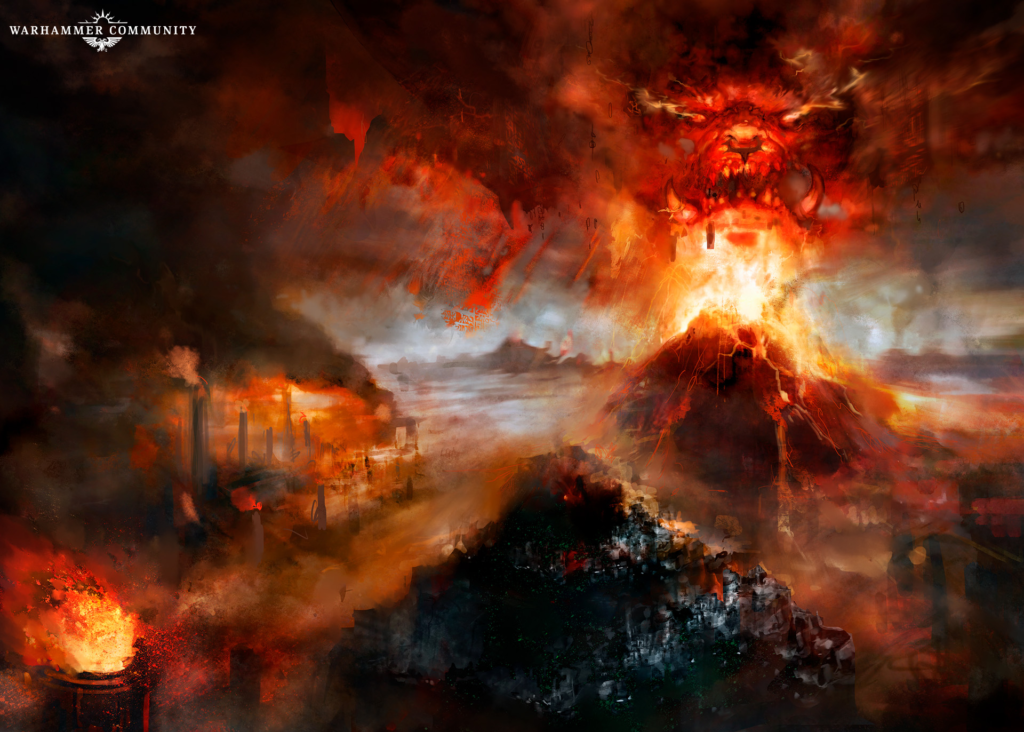
Those words ultimately destroyed the bond between the brothers. Hashut interpreted the accusations and insults as a betrayal, believing that he was no longer bound by the oaths he had sworn. None of his siblings defended him, not even Valaya, for whom he would have granted any request. Consumed by resentment, he ventured into the Realm of Chaos, where he discovered forbidden knowledge that allowed him to bend daemons to his will. During his journey, he reached the Forge of Souls, a place where he obtained extraordinary power that he would use to prepare his revenge against the other Ancestor Gods.
When Hashut returned, he unleashed his fury upon his siblings, inflicting terrible damage upon the pantheon. According to the Helsmiths, only one final, desperate intervention by Valaya managed to destroy his physical form, although the price was immense, as the goddess herself disappeared after the confrontation. Following that battle, the Ancestor Gods supposedly attempted to erase all memory of Hashut, forbidding his worship, sealing his temples, and condemning his name to oblivion. However, his followers secretly preserved his memory, awaiting the moment of his return.
Beyond this account, traditional duardin sources describe the Thagduegi as a series of acts of betrayal that led to the fragmentation of the pantheon. Following these events, Grungni and Grimnir were chained to the highest peak of the Iron Mountains of Chamon, while Grungni suffered grievous wounds that left him almost incapacitated. Some legends even claim that it was the forge god himself who created the chains that imprisoned both brothers, although no one knows what reasons could have driven him to such an act.
The Thagduegi marked the end of the ancient unity of the Ancestor Gods. Its members followed different paths, and the fate of some, such as Valaya, became shrouded in uncertainty. However, the story of Grungni and Grimnir was far from over. Both would remain chained in the Iron Mountains until, sometime later, a new deity travelled through Chamon and discovered their prison: Sigmar, the God-King.
Upon witnessing their plight, he decided to free them, breaking the bonds that held them captive. Grateful for this act, both Ancestor Gods swore solemn oaths, pledging to repay the favour. However, each would fulfil his promise in his own way, following his own nature.
Grungni, the Great Maker, decided to use his extraordinary knowledge of engineering and craftsmanship to help Sigmar develop the civilizations of the Mortal Realms. One of his first great contributions was mediating between the early clans of the Khazukan and the Twelve Tribes of Azyr, establishing a lasting peace between duardin and humans. Later, he began gathering the scattered duardin clans and guiding them in the construction of a powerful civilization that would eventually become the Khazalite Holds.
Under his guidance, the duardin built enormous strongholds, underground cities, and extraordinary feats of engineering, expanding their domains across the Mortal Realms. In Chamon, Grungni created some of his greatest wonders, including the Nineteen Great Wonders of Chamon, while his collaboration with Sigmar led him to participate in the construction of such important works as the Sigmarabulum and the Anvil of Apotheosis, both fundamental to the eventual creation of the Stormcast Eternals.
Meanwhile, Grimnir, the God of War, was determined to repay his debt in a far more direct manner. True to his warrior nature, he asked Sigmar to name an enemy worthy of his power, one he could face in single combat. The God-King, aware of Grimnir’s pride and fearful of offending him by offering an unworthy opponent, eventually chose Vulcatrix, the Mother of Salamanders, one of the most powerful godbeasts of Aqshy, the Realm of Fire.
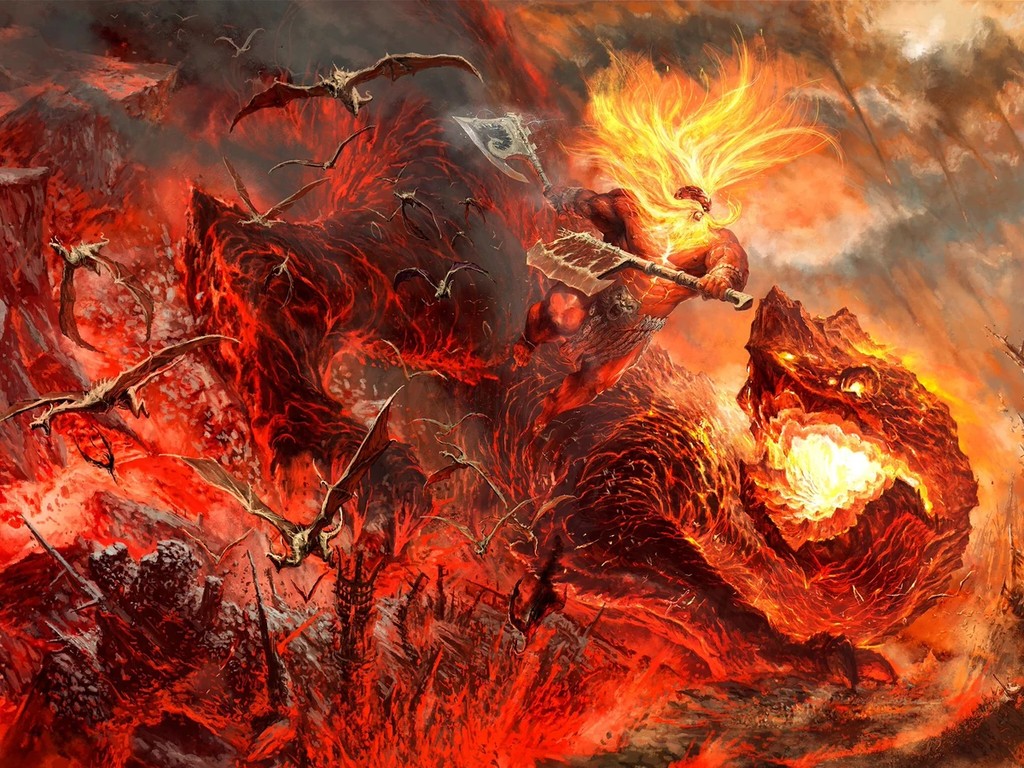
Grimnir set out in search of the creature, and when he finally found her, the two engaged in a battle of apocalyptic proportions. For days, the warrior god and the godbeast exchanged blows powerful enough to reshape the landscape, devastating mountains and tearing enormous rifts in the earth. Eventually, Grimnir managed to slay Vulcatrix, but the creature’s death throes triggered a devastating explosion known as the Zharrkhul, which also destroyed his physical form.
Grimnir’s divine essence was scattered across the Mortal Realms, mingling with the burning blood of Vulcatrix and giving rise to ur-gold, a sacred metal that his followers would learn to use to channel a portion of their god’s power. From that moment onwards, the Fyreslayers would dedicate much of their existence to recovering this material, convinced that one day they could reunite the fragments of their deity and bring about his return.
Thus, the encounter with Sigmar marked a turning point in duardin history. While Grimnir met his fate in one final, glorious battle, Grungni became one of the great architects of the prosperity of the Age of Myth. Under his influence, the Khazalite Holds would reach an era of unprecedented splendour, raising strongholds and wonders that would endure for generations, their legacy still echoing among the duardin clans of the Mortal Realms.
I hope you enjoyed the first part of the Khazalite Holds lore. Next week, we’ll have a new chapter exploring the evolution of these stubborn duardin from the Age of Myth to the present day in the game.
Remember, you can find all the latest releases at our sponsor, WarGen Wargames, with a 20% discount. Plus, by using our code ILOVETGH, you’ll get an additional 5% off.
¿Queréis aprender más sobre Age of Sigmar? ¿Hay algún tema que os gustaría que tratáramos en futuros artículos o vídeos?
¡Contádnoslo en los comentarios! También podéis hacernos llegar vuestras sugerencias a través de nuestro Instagram.
Vuestra opinión nos ayuda a seguir creando el contenido que realmente queréis ver.

Descubre más desde The Generals Hub
Suscríbete y recibe las últimas entradas en tu correo electrónico.

The Generals Hub
Aquí encontrarás las últimas noticias de Age of Sigmar, mucho hobby, análisis del metajuego, estrategia y contenido para disfrutar al máximo del universo de los Ocho Reinos.
Leave a Reply